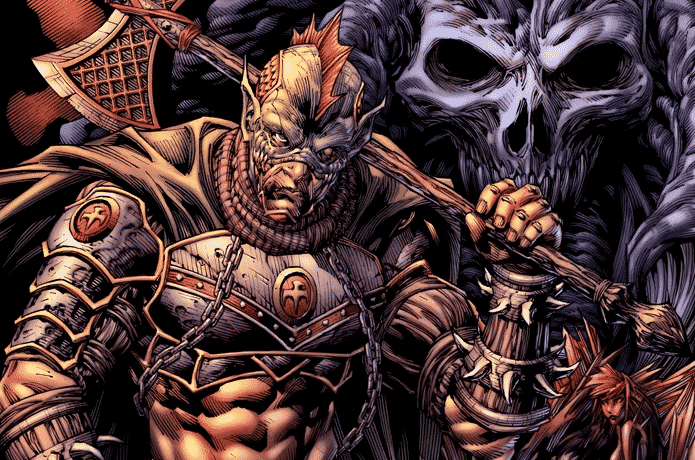
In this demonstration we’ll continue working on Goliath, a comic book character concept I designed for Rob Arnold’s Replicator comic book series.
Find out more about Replicator here: https://igg.me/at/Replicator1/x/20658139#/
If you missed the previous tutorials in this series, you can check them out via the links below.
Goliath – Part 1: https://youtu.be/PFzA4B2a95c
Goliath – Part 2: https://youtu.be/JuQOQlvfEk4
Goliath – Part 3: https://youtu.be/k141zYdHqaM
Goliath – Part 4: https://youtu.be/q6k17agdJVU
The whole idea of creating a character sheet is to give them a comprehensive presentation from key points of view. So having completed the three quarter turn of Goliath’s full figure, we’ll now move onto a new concept drawing that shows us a head shot of him from the front.
An important consideration to make when it comes to designing characters is contrast. Contrast between the various values, materials, textures and elements throughout the concept. Contrast helps break up a character visually, making them easier to interpret, while at the same time adding interest and memorability to their design.
So as I work, my goal is to make distinctions within my rendering and detailing style to emphasize visual variety. In Goliath’s example, we want to be able to tell that his exposed areas of skin are a significantly different texture and material to the metal armor covering his jaw and face.
While we want to integrate visual contrast, we also want to maintain consistency between each of the different viewpoints we’ve illustrated for Goliath. So as I work on the cropped portrait shot of his head, I’m crosschecking it with the three quarter, full body shot I’ve already completed.
Remember that the reason we’re doing up a character sheet for Goliath in the first place is so that it can be used as a reference to maintain consistency between the various angles, viewpoints and perspectives he’ll be drawn in, inside the sequential narrative.
Another topic we’ll talk about in this tutorial is the idea of compound learning. Here we consider the advantage of learning the same concepts in different contexts to improve our knowledge and abilities in multiple disciplines.
I hope that you enjoy today’s tutorial and that you can a ton of value out of it. Try out some of the tactics and techniques you’ve learned about in this video and let me know how you go in the comments below.
PLEASE NOTE: The Goliath video series may not always be available for free. There’s a good chance it’ll be taken down, re-edited and packaged up as a premium product later on. So if you find this lesson valuable, please make the most of it while it’s available for free, by taking notes and putting as much of it as you can into practice. Save the video onto your hard drive as well if you’d like, so that you can refer back to it later on.
Thanks so much for watching, until next time – keep on drawing!
-Clayton
Software Used: Clip Studio Paint/Manga Studio
If you like the video, show your support by commenting, sharing or subscribing.
Comic Art Community – https://www.howtodrawcomics.net/comic-art-community/
How to Draw Comics .NET – http://www.howtodrawcomics.net/
Instagram – https://www.instagram.com/howtodrawcomics/
Facebook – https://www.facebook.com/howtodrawcomics
Twitter – https://twitter.com/howtodrawcomics
Tumblr – http://howtodrawcomics.tumblr.com/
Pinterest – http://www.pinterest.com/howtodrawcomics/